
| Kingdom : | Animalia |
| Phylum : | Chordata |
| Class: | Mammalia |
| Order : | Artiodactyla |
| Family : | Cervidae |
| Genus : | Cervus |
| Species : | C. duvaucelii |
| Zoological name : | Cervus duvaucelii |
| Found In | Kaziranga, Kanha, Dudhwa and Manas National Park |
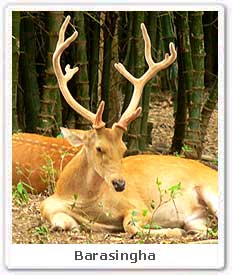 Physical appearance : Barasingha stands up to 130 cm and
weigh around 170- 180 kg. It is a medium size deer. It is dense brown in
colour. It's underparts are white in colour. Male antlers are up to 75 cm
long and can have more than 12 points. It has high legs, short head and long
broad ears. They have long and broad hooves. They have log hairs around its
neck. It coat becomes darker during the mating season.
Physical appearance : Barasingha stands up to 130 cm and
weigh around 170- 180 kg. It is a medium size deer. It is dense brown in
colour. It's underparts are white in colour. Male antlers are up to 75 cm
long and can have more than 12 points. It has high legs, short head and long
broad ears. They have long and broad hooves. They have log hairs around its
neck. It coat becomes darker during the mating season. Presence in India : Barasingha is mostly found in North India, Central India and North East India. They are widely spotted in the Kaziranga, Kanha, Dudhwa and Manas National Park. They can also be located throughout the basins of the Indus, Ganges and Brahmaputra river.
Habitat : Barasingha prefers moist forest, swamplands, tall grass and reed beds near water.
Diet : Barasingha are herbivorous. They feed om aquatic plants, leaves,and grasses. It drinks atleast twice a day during the summer season.
Sub-species of Barasingha : Wetland barasingha (Cervus duvaucelii duvaucelii), upland barasingha (C. d. branderi), C. d. ranjitsinhi
Reproduction : Barasingha usually breeds during the month of November and December. Gestation period rests for 240 -250 days after which the female gives give birth to one or two young. They reach the level of sexual maturity at 2 years of age. Males turn dark during the breeding season. Only the dominated males (those who wins the fights) get the chance to mate with the females. Breeding herds are mixed of males, females and does. Herds mainly consists of 20-30 members.
Conservation status : Classified as Vulnerable (VU C1) on the IUCN Red List 2002, and listed on Appendix I of CITES. The destruction of their habitat due to deforestation has seriously declined the population of Barasingha. They are being haunted for their horns.
Lifespan : Barasingha lives up to 23 years of age.