

| Kingdom : | Animalia |
| Phylum : | Chordata |
| Class: | Mammalia |
| Order : | Carnivora |
| Family : | Bovidae |
| Subfamily : | Antilopinae |
| Genus : | Gazella |
| Species : | G. bennettii |
| Zoological name : | Gazella bennettii |
| Found In : | Bandhavgarh National Park and Ranthambore National Park |
 Physical
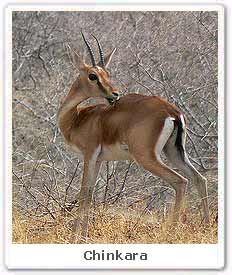
appearance : Its total height is 65 cm and weigh around 23 kg. Males
have short horns. Horns of the females are soft or missing. Its summer coat
is warm biscuit or reddish in colour, with smooth glossy fur. In winter the
white belly or throat fur is in greater contrast. The sides of the face have
dark chestnut stripes from the corner of the eye to the muzzle bordered by
the white stripes. It's tail is covered with a dorsal crest of black hairs.
It is the smallest antelope found in Asia.
Physical
appearance : Its total height is 65 cm and weigh around 23 kg. Males
have short horns. Horns of the females are soft or missing. Its summer coat
is warm biscuit or reddish in colour, with smooth glossy fur. In winter the
white belly or throat fur is in greater contrast. The sides of the face have
dark chestnut stripes from the corner of the eye to the muzzle bordered by
the white stripes. It's tail is covered with a dorsal crest of black hairs.
It is the smallest antelope found in Asia. Presence in India : Chinkara is widely distributed in India. It is mostly found in Rajasthan, north western and central parts of India. They could also be spotted in the Bandhavgarh and Ranthambore National Park.
Habitat : Chinkara prefers grasslands, desert areas, woodlands and shrub lands to live.
Diet : Their diet include all types of vegetation. The feed on grass, leaves and wild fruits. They can live without water for longer period of time.
Reproduction : Chinkara can mate throughout the year. Gestation period lasts for 5 -6 months. Females give birth to one or two young ones. There are two birth peaks the major one in April and the minor one in Autumn.
Conservation status : Endangered species, considered as extremely vulnerable. It is widely haunted for games.
Lifespan : The lifespan of Chinkara is upto 12 - 15 years.