

| Kingdom : | Animalia |
| Phylum : | Chordata |
| Class: | Mammalia |
| Order : | Artiodactyla |
| Family : | Cervidae |
| Subfamily : | Cervinae |
| Genus : | Axis |
| Species : | A. axis |
| Zoological name : | Axis axis |
| Found In : | Corbett National park, Kanha National Park, Bandhavgarh National Park and Sariska Tiger Reserve |
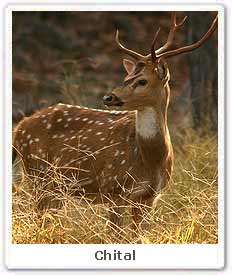 Physical appearance : Chital are 90 cm tall and weigh up
to 85 kg. Its upper parts are reddish fawn and the under parts are white in
colour. It has white spots all over the body. Antlers are present in males
only that may exceed up to 75 cm. They shed them anually. Their antlers have
six point plan. They are tuned back into the upward curve and have three
points each. These antlers are used in mating displays and for the purpose
of protection. They have white patch on the throat. They have a black dorsal
stripe that run down their backs. They are good swimmers.
Physical appearance : Chital are 90 cm tall and weigh up
to 85 kg. Its upper parts are reddish fawn and the under parts are white in
colour. It has white spots all over the body. Antlers are present in males
only that may exceed up to 75 cm. They shed them anually. Their antlers have
six point plan. They are tuned back into the upward curve and have three
points each. These antlers are used in mating displays and for the purpose
of protection. They have white patch on the throat. They have a black dorsal
stripe that run down their backs. They are good swimmers. Presence in India : They are easily found in the jungles of India. They are easily spotted in the wild parks of India such as Corbett, Kanha, Dudhwa, Bandhavgarh, Mudumalai, Sariska.
Habitat : Chital prefers terrestrial, woodland, forests and clearings near water ways. They are usually found in the herds of 10 - 20 individuals.
Diet : Chital mainly feeds on grasses and browsed vegetation. They also favours wheat, fruits, herbs, flowers and leaves. They feed for four hours after sunrise and for two hours before sunset.
Reproduction : Chital reach the sexual maturity at 12 -14 months. Gestation lasts for seven months. Mating season of the Cheetal or Axis Deer varies geographically. Estrus in females occur throughout the year. Females give birth to one to three fawns. Fawns are born throughout the year. Young ones are weaned at 6 months.
Conservation status : Not threatened. Deforestation and loss of habitat has seriously declined the population of Chital. They are widely haunted for games. Their main threats are wild dogs and leopards.
Lifespan : Lifespan of the Chital is around 20 -30 years.