

| Kingdom : | Animalia |
| Phylum : | Chordata |
| Class: | Mammalia |
| Order : | Artiodactyla |
| Family : | Bovidae |
| Subfamily : | Caprinae |
| Genus : | Hemitragus |
| Species: | H. jemlahicus |
| Zoological name : | Hemitragus jemlahicus |
| Found In : | Jim Corbett National Park in India |
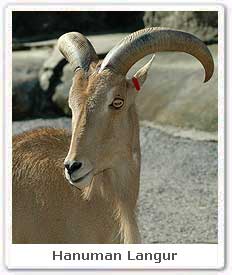 Physical appearance : Himalayan Tahr are 3- 4.5 feet
long and weigh around 36-90 kg. They are 26 – 40 inches tall. They have
small head and relatively short legs. They have large eyes and small as well
as pointed ears. They have triangle shaped horns, curved abruptly backwards
and than inwards. In winters Tahr has dense, reddish to dark brown woolly
coat with a thick undercoat. In the spring they lose much of their coat, and
it becomes lighter in color.
Physical appearance : Himalayan Tahr are 3- 4.5 feet
long and weigh around 36-90 kg. They are 26 – 40 inches tall. They have
small head and relatively short legs. They have large eyes and small as well
as pointed ears. They have triangle shaped horns, curved abruptly backwards
and than inwards. In winters Tahr has dense, reddish to dark brown woolly
coat with a thick undercoat. In the spring they lose much of their coat, and
it becomes lighter in color. Presence in India : Himalayan Tahr is found in the Southern parts of India.Himalayan mountains from Bhutan to Kashmir. They are also spotted in the Jim Corbett National Park .
Habitat : Himalayan Tahr prefers mountain slopes and mountain woodlands of the Himalayas
Diet : Himalayan Tahr are herbivorous. They feed on grasses , leaves, vegetation, shrubs and trees.
Reproduction : Himalayan Tahr reach the level of sexual maturity at 2-3 years of age. They usually mate during the winter season. Gestation period rests for seven months. Normal number per litter is one or two. They are weaned at about 6 months.
Conservation status : The Himalayan tahr is considered vulnerable by the IUCN (1996) in its home range of the Himalayas.
Lifespan : Himalayan Tahr can live up to the 22 years of age.