

| Kingdom : | Animalia |
| Phylum : | Chordata |
| Class: | Mammalia |
| Order : | Artiodactyla |
| Family : | Camelidae |
| Genus : | Camelus |
| Zoological name : | Camelus bactrianus |
| Found In : | Kaziranga and Desert National Park in India |
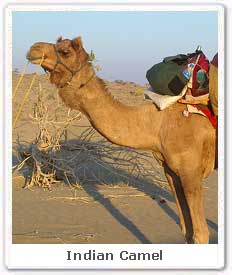 Physical appearance : Indian Camel is 6 feet long and
weighs around 700 kg. It is 7 feet high from its hump. It tail is 50 cm
long. It is characterized by long curved neck, large mouth and high hump.
They are usually brown or black in colour. Camel's nasal passages are
properly covered with the large muscular nostrils. Camels have thin, long
and powerful legs. They have large eyes with long eyelashes and bushy
eyebrows.but small ears. Indian camels have broad, flat and leathery pads
with two toes on each foot with leathery patches on their knees.
Physical appearance : Indian Camel is 6 feet long and
weighs around 700 kg. It is 7 feet high from its hump. It tail is 50 cm
long. It is characterized by long curved neck, large mouth and high hump.
They are usually brown or black in colour. Camel's nasal passages are
properly covered with the large muscular nostrils. Camels have thin, long
and powerful legs. They have large eyes with long eyelashes and bushy
eyebrows.but small ears. Indian camels have broad, flat and leathery pads
with two toes on each foot with leathery patches on their knees. Species : Camelus bactrianus, Camelus dromedarius, Camelus gigas, Camelus hesternus, Camelus sivalensis
Presence in India : India Camel is mostly found in the North Western part of India.They are also spotted in the Kaziranga and Desert National Park.
Habitat : Camels mostly prefer dry places.
Diet : Camels are herbivorous. They feed on grass, grains, wheat, oats, dried leaves, and seeds . As their humps contain fat, they can go without food for 3-4 days.
Reproduction : Camels reach the level of sexual maturity at 4-5 years of age. The gestation period lasts for 13 months after which the a single calf is born. The calves start walking within two hours of birth.
Conservation status : IUCN Red List of Threatened species.
Lifespan : Camel lives up to the 40 years of age.