
| Kingdom : | Plantae |
| Division | Magnoliophyta |
| Class: | Magnoliopsida |
| Order : | Sapindales |
| Family : | Meliaceae |
| Genus : | Swietenia |
| Species : | S. mahagoni |
| Scientific Name : | Swietenia mahagoni |
| Found In : | Thattekkad Wildlife Sanctuary, Kaziranga National Park and Corbett National Park |
Other names : Mahogany, West Indian Mahogany, Spanish mahogany, Madeira redwood, acajou, caoba, caoba de Santo, cheria mahogany, Cuban mahogany, American mahogany, True mahogany, small leaf mahogany, Dominican mahogany are some of the other names of Indian Mahogany.
Description : Indian Mahogany grow up to the height of 30 -40 feet. It is fast upright growing tree with abroad rounded symmetrical crown. It is 20 -30 feet in spread. The fruit is a large greenish brown capsule, splitting into 5 parts relwasing flat, long winged, light brown seeds. Its wood is red brown
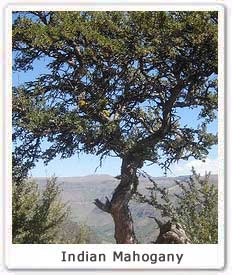 in
colour. Both the male and the female flowers are produced on the same plant.
The bark is smooth dark brown in colour. The leaves are pinnate which are 12
-25 cm long, with four to eight leaflets.
in
colour. Both the male and the female flowers are produced on the same plant.
The bark is smooth dark brown in colour. The leaves are pinnate which are 12
-25 cm long, with four to eight leaflets.Other Species : Swietenia humilis , Swietenia candollei, Swietenia fabrilis, Swietenia mahagoni, Swietenia macrophylla are the other related species of the Indian Mahogany.
Location : India Mahogany is found in almost all the parts of India. It can also be found in Thattekkad Wildlife Sanctuary, Kaziranga National Park and Corbett National Park in India.
Cultivation methods :Indian Mahogany is mostly propagated through seeds. It requires partial shade or full Sun for its growth. It needs water periodically. It looses its leaves at the end of the winter. The new leaves start growing after two three weeks. The new leaves are reddish purple in colour, which turn yellow green afterwards.
Medicinal uses : The bark extracts are used as an astringent for wounds. It is used to cure malaria, anemia diarrhea, fever, dysentery and depurative. The leaves contain several limonoids; seven phragmalin limonoids of swietephragmins A-G as well two other different types of 2-hydroxy-3-O-tigloylswietenolide and deacetylsecomahoganin.
Other uses : Its wood is used in making furniture, fixtures, musical instruments, inlay, boat, caskets and many more. Its wood is a very popular material for drum making.