

| Kingdom : | Animalia |
| Phylum : | Chordata |
| Class: | Aves |
| Order : | Gruiformes |
| Family : | Otididae |
| Genus : | Ardeotis |
| Species : | A. nigriceps |
| Zoological name : | Ardeotis nigriceps |
| Found In | Sultanpur Bird Sanctuary (Gurgaon), Desert National Park (Rajasthan) and the Lala-Parjau sanctuary in western Kutch (Gujarat) |
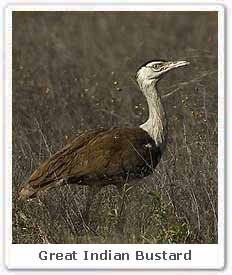 Physical appearance : Males are 120 cm long and weigh
around 18 kg. Females are generally 92 cm longand weigh around 6 kg. Males
weigh around three times more than the females. Its underparts and neck is
white in colour, it has a black clown on its forehead and and its upperparts
are brown in colour. Males have larger crown as compared to the females. It
is tall long legged bird. Its wings are black, brown and gray in colour.
Both males and females are similar in appearance.
Physical appearance : Males are 120 cm long and weigh
around 18 kg. Females are generally 92 cm longand weigh around 6 kg. Males
weigh around three times more than the females. Its underparts and neck is
white in colour, it has a black clown on its forehead and and its upperparts
are brown in colour. Males have larger crown as compared to the females. It
is tall long legged bird. Its wings are black, brown and gray in colour.
Both males and females are similar in appearance. Presence in India : Great Indian Bustard is mostly found in the Gujrat, Madhya Pradesh, Jammu and Kashmir, Karnataka, Andhra Pradesh and West Rajasthan. It is mainly spotted in the the Desert National Park (Rajasthan) and the Lala-Parjau sanctuary in western Kutch (Gujarat).
Habitat : Great Indian Bustard prefers short grass plains, desert plains and semi arid regions.
Diet : Great Indian Bustard is omnivorous and feeds on beetles, grasshoppers, seeds and groundnuts.
Reproduction : It makes nest in the open ground, where incubated by female for about 25 days; fledging period 30–35 days. It usually lay single egg in an year. First breeding occurs at 5–6 years in males and 2–3 years in females. Males take no part in nourishing the young ones.
Conservation status : (Vulnerable) Great Indian Bustard has been declared as the endangered species, as its population is very less in number. Due to haunting and greater use of pesticides, the population of Great Indian Bustard is continuously declining. As these birds do not live in birds, so there is greater risk of their eggs destruction. The largest protected area of the Great Indian Bustard is the Desert National Park in India.
Lifespan : Unknown